
- May 21, 2026
- 0 Comment
Every year, we get calls from facility managers who thought they had their fire safety sorted. They had the NOC. They had done the audit. And then something went wrong — an insurance claim got rejected, a government inspector flagged violations, or worse. When we dig into what happened, the answer is almost always the same: they hired the wrong firm.
Picking a fire safety audit company in India is not like buying a service. It is a decision that sits between your people and a serious risk. Get it right and you have a genuine safety foundation. Get it wrong and you have a certificate that gives you false confidence — which is arguably more dangerous than having nothing at all.
So here are the 7 questions we would ask before signing with anyone.
Why Getting This Decision Right Actually Matters
India loses somewhere between 13,000 and 15,000 people to fire-related causes every year. That number has not meaningfully changed in a decade, despite stronger regulations. Part of the reason is enforcement — but a bigger part is the gap between fire audits that look good on paper and those that actually make buildings safer.
A 2024 study in Nagpur found that only 12% of 577 industrial units followed through on fire safety steps after receiving their NOC. Most had done the audit. Most had ticked the box. And most had done nothing with what the audit found.
That pattern starts at the vendor selection stage. If you hire a firm that produces a generic checklist PDF and calls it an audit, you will end up in that 88%.
India’s fire protection systems market hit $2.3 billion in 2024 and is growing rapidly — partly because insurers are now requiring detailed audit trails before renewing industrial policies. The stakes on both sides — legal and commercial — are real.
One thing to clarify before you start There are two very different things that get called a ‘fire safety audit’. A basic compliance check asks whether the required equipment is present and whether boxes are ticked. A comprehensive fire safety audit asks whether the equipment actually works, whether the risks are genuinely understood, and whether the building is truly prepared. Always clarify upfront which one you are being quoted for. They are not interchangeable. |
The 7 Questions to Ask Before You Hire Anyone
Question 1: Are your auditors certified — and certified for my type of facility?
Credentials matter, but not in the way people usually assume. A certificate on a wall does not tell you much. What tells you more is whether the auditor has relevant qualifications — fire engineering backgrounds, NFPA training, NEBOSH certification, or alignment with BIS standards — and whether they have actually worked in your sector. A hospital has completely different fire risk dynamics from a chemical plant. An auditor who has spent most of their career on office buildings will miss things in a pharmaceutical warehouse that an experienced industrial specialist would catch in the first hour. Ask for certifications. Then ask for sector-specific references — actual clients in your industry type, within the last two years. See our fire safety audit services to understand what a credentialled audit looks like. |
At a glance — what to ask: ✓ Are the auditors formally qualified — fire engineering, NFPA, NEBOSH, or BIS-aligned? ✓ Do they have hands-on experience in my specific industry (pharma, manufacturing, hospital, etc.)? ✓ Can they provide references from comparable facilities audited in the last 18 months? |
Quick takeaway: Qualifications are the starting point, not the endpoint. Sector experience is what separates a good audit from a relevant one. |
Question 2: Which specific standards does your audit cover?
This question trips up a surprising number of firms. A credible fire safety audit company in India should be able to name the regulatory framework without hesitation — because it is the foundation of everything they do. The standards that apply to most Indian facilities include the National Building Code 2016 Part 4 (Fire and Life Safety), IS 2189 for fire alarm systems, IS 15105 for fire hazard properties, the Factories Act 1948 for industrial premises, NFPA codes for suppression systems, and the state-specific Fire Service Acts that govern NOC requirements. If a firm is vague about which standards they audit against — if they say ‘we follow all applicable regulations’ without naming them — that is a problem. Non-NBC-compliant audits can leave you legally exposed even after you have paid for and received a report. |
At a glance — what to ask: ✓ Can they cite NBC 2016 Part 4, IS 2189, IS 15105 specifically? ✓ Do they know the Factories Act 1948 requirements for your facility type? ✓ Are they up to date on state-level Fire Service Act and NOC requirements for your city? |
Quick takeaway: A firm that cannot name the standards immediately is not working from the standards. They are working from a template. |
Question 2: Which specific standards does your audit cover?
This question trips up a surprising number of firms. A credible fire safety audit company in India should be able to name the regulatory framework without hesitation — because it is the foundation of everything they do. The standards that apply to most Indian facilities include the National Building Code 2016 Part 4 (Fire and Life Safety), IS 2189 for fire alarm systems, IS 15105 for fire hazard properties, the Factories Act 1948 for industrial premises, NFPA codes for suppression systems, and the state-specific Fire Service Acts that govern NOC requirements. If a firm is vague about which standards they audit against — if they say ‘we follow all applicable regulations’ without naming them — that is a problem. Non-NBC-compliant audits can leave you legally exposed even after you have paid for and received a report. |
At a glance — what to ask: ✓ Can they cite NBC 2016 Part 4, IS 2189, IS 15105 specifically? ✓ Do they know the Factories Act 1948 requirements for your facility type? ✓ Are they up to date on state-level Fire Service Act and NOC requirements for your city? |
Quick takeaway: A firm that cannot name the standards immediately is not working from the standards. They are working from a template. |
Question 3: Will your team actually come to my site?
At a glance — what to ask: ✓ Is a physical site visit included — not optional? ✓ What instruments and testing equipment does the team bring on site? ✓ Does the audit include thermographic scanning of electrical panels? ✓ How many auditor-days are allocated for a facility of my size? |
Quick takeaway:If the entire audit can happen without anyone visiting your building, it is not an audit. Walk away. |
Question 4: What does the audit report actually include?
At a glance — what to ask: ✓ Is a physical site visit included — not optional? ✓ What instruments and testing equipment does the team bring on site? ✓ Does the audit include thermographic scanning of electrical panels? ✓ How many auditor-days are allocated for a facility of my size? |
Quick takeaway:If the entire audit can happen without anyone visiting your building, it is not an audit. Walk away. |
Question 4: What does the audit report actually include?
At a glance — what to ask: ✓ Is there a compliance summary mapped to actual named standards? ✓ Does it include site-specific photographs as evidence? ✓ Are hazards ranked by severity with prioritised action timelines? ✓ Is there a scoring or grading system so you know where you stand? |
Quick takeaway: The report is the product. Seeing a real sample report is the single most reliable way to assess an audit firm before you hire them. |
Question 5: Do you cover passive fire protection — not just the active systems?
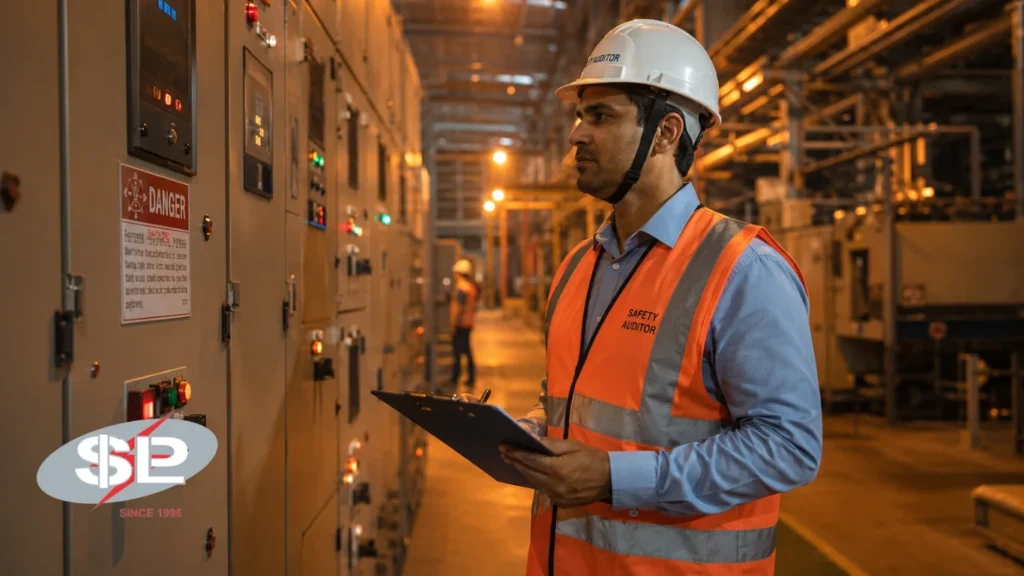
Most people think of fire safety equipment when they think of fire audits. Sprinklers. Extinguishers. Alarms. Hydrants. Those are the active systems, and yes, they matter enormously. But passive fire protection is what stops a fire from spreading through a building once it starts — fire-rated walls, compartment doors, structural fire resistance, cable protection systems, proper sealing of penetrations. An audit that ignores passive protection is giving you half a picture. Unprotected structural steel can lose significant load-bearing capacity within minutes of fire exposure. Ask whether the audit includes a structural fire safety review and a fire load study — the calculation of how much heat energy your facility could release in a worst-case fire. |
At a glance — what to ask: ✓ Does the scope include passive systems — fire doors, compartmentation, cable protection? ✓ Is a structural fire resistance review included or available? ✓ Do they conduct a fire load study to calculate worst-case heat release? |
Quick takeaway: Active systems respond to fire. Passive systems contain it. You need both assessed — not just the ones with flashing lights. |
Question 6: How do you handle what you find — and what if the findings are serious?
At a glance — what to ask: ✓ Do they debrief you in person after the audit — not just send a PDF? ✓ Are they available to answer questions during the remediation period? ✓ Do they offer a follow-up verification audit once corrections are made? ✓ Can they help prioritise which findings to address first based on risk level? |
Quick takeaway: The gap between finding a hazard and fixing it is where most audits fall apart. Make sure your firm stays in the room. |
Question 7: What happens after the audit — do you stay involved?
This is the question almost nobody asks, and almost everybody wishes they had. Implementing fire safety recommendations is where the real work happens — and it throws up questions constantly. New equipment needs integrating. Structural modifications raise follow-on compliance questions. Staff need to understand what changed and why. A firm worth hiring will offer a post-audit implementation session, availability during the remediation period, a verification re-audit once corrections are made, and ideally fire safety training for your team so the knowledge does not stay locked in the report. Firms that hand over a PDF and go quiet are giving you a document, not a safety outcome. |
At a glance — what to ask: ✓ Do they offer a post-audit implementation guidance session? ✓ Will they answer questions during the correction period? ✓ Is a verification re-audit available once fixes are made? ✓ Do they provide fire safety training for your team as part of the engagement? |
Quick takeaway: An audit that ends at the report stage is a compliance exercise. An audit that stays with you through implementation is a safety investment. |
Five Warning Signs to Watch Out For
You will encounter all of these if you shop around long enough:
- Vague standards language. ‘We follow all applicable regulations’ is not an answer. Push for the specific codes.
- Suspiciously fast turnarounds. A thorough audit of a medium-sized industrial plant takes days. A 24-hour turnaround is a red flag.
- No physical site visit. If the entire audit can be done remotely, it is not an audit.
- Generic sample reports. If their sample looks like a template with your name pasted in, that is exactly what you will get.
- They also sell the equipment. An audit firm that profits from selling remediation systems has a conflict of interest. Independence matters.
Fire Safety Does Not Sit in Isolation
Something we see often: a factory commissions a fire safety audit and comes out the other side realising they have interconnected gaps they had not anticipated.
Electrical faults cause around 22% of workplace fires in India. An electrical safety audit identifies overloaded circuits, earthing failures, and panel hazards — the things that start fires before any alarm has a chance to respond.
For high-voltage industrial facilities, an arc flash study identifies the risk of explosive electrical discharges — which sit at the intersection of electrical and fire risk, and which most standard fire audits do not cover.
Older buildings often have structural fire safety gaps that a structural audit can surface — particularly where construction predates modern NBC standards.
Combining fire and energy audits gives you a complete picture of how your electrical infrastructure performs. See our energy audit services for more.
Questions People Actually Ask About Fire Safety Audits in India
Yes, for most commercial and industrial facilities it is. The National Building Code 2016, the Factories Act 1948, and state-level Fire Service Acts all mandate periodic fire audits and documented NOC compliance. Operating without a valid fire audit creates direct legal exposure — including fines, licence cancellation, or forced closure.
For most high-risk and commercial facilities, annually — and that satisfies most regulatory and insurance requirements. Industrial premises with chemical storage or high fire loads should audit every 6 to 12 months. After any significant renovation or fire incident, a re-audit should happen promptly.
A basic compliance audit for a small commercial premises might run Rs 15,000 to Rs 25,000. A comprehensive audit for a large industrial plant or hospital typically starts from Rs 75,000 and can go significantly higher for complex multi-site facilities. Always ask exactly what the quoted price includes.
A fire risk assessment identifies what hazards exist and what basic controls are in place. A fire safety audit is more formal and thorough — it evaluates whether fire protection systems, equipment, procedures, and compliance frameworks are actually working. Most regulators and insurers want the audit.
You can, but think carefully. A firm that profits from selling sprinklers or alarms has a financial interest in telling you your existing systems are inadequate — even when they are not. Wherever possible, keep the audit and the remediation supply chain separate.
Failing is not the same as being shut down. It produces a non-conformance report — a list of what needs fixing, in what order, and with what urgency. Critical deficiencies need immediate action. Lower-risk findings typically have a 30 to 90 day correction window. A follow-up verification audit then confirms compliance.
In Delhi NCR, the requirements cover commercial buildings above certain floor area thresholds, hospitals, hotels, educational institutions, factories, warehouses, malls, and high-rise residential buildings — under Delhi Fire Service Rules and NBC 2016. Thresholds vary by building type, so consult a certified fire safety audit agency in Delhi or Gurugram to confirm your obligations.
One Last Thing Before You Start Calling Around
Singh Isotech Pvt. Ltd. has been doing this for over 30 years. We are based in Gurgaon and work across India — industrial plants, commercial complexes, hospitals, hotels, schools, and manufacturing facilities. Every audit is conducted on-site, by certified professionals, referenced to the actual regulatory standards that apply to your building.
We do not sell fire equipment. We do not have a product line that benefits from recommending replacements. Our only commercial interest is the audit itself — which is exactly how it should be.
Start with our fire safety audit services page, or reach out directly and we will give you a straight answer about your facility.
Also explore: Electrical Audit | Energy Audit | Structural Audit | Safety Audit | Arc Flash Study | Fire Safety Training

