
-
August 10, 2026
- 0 Comment
If your compressor’s electricity bill keeps creeping up even though production hasn’t changed, leaks are usually the reason. Compressed air is one of the most expensive utilities to generate in any Indian manufacturing plant, and it’s also the one most often wasted without anyone noticing — until the cost of compressed air leaks shows up as a line item nobody can explain.
How much do compressed air leaks cost?Industrial plants typically lose 20–30% of their compressed air output to leaks. Depending on compressor size, operating pressure, electricity tariffs, and running hours, that can translate into tens of thousands to several lakh rupees a year for an Indian factory. |
What Is the Cost of Compressed Air Leaks in India?
free at the point of use, but it is one of the costliest utilities to generate. Compressors run continuously to hold system pressure, and every leak forces them to work harder and longer to make up for lost air. With industrial electricity tariffs rising across most Indian states, that inefficiency has a real, growing rupee cost attached to it.
The size of a leak matters more than most people expect. A single 3mm hole in a pipe running at typical industrial pressure can waste enough compressed air over a year to noticeably move your electricity bill — and most facilities don’t have just one leak. Here’s roughly what different leak sizes cost annually (based on typical Indian industrial tariffs and operating hours; actual figures vary with pressure and usage):
Leak Size | Estimated Annual Cost |
1 mm | ₹6,000 – ₹12,000 |
2 mm | ₹20,000 – ₹40,000 |
3 mm | ₹60,000 – ₹1,20,000 |
5 mm | ₹2,00,000+ |
These are approximate estimates. Actual leak cost depends on operating pressure, compressor efficiency, running hours, and your electricity tariff — an on-site survey gives you exact figures for your facility.
This isn’t a problem specific to one industry. We see it consistently across automotive component plants, pharmaceutical factories, food processing units, textile mills, and cement plants — anywhere compressed air runs pneumatic tools, actuators, or process equipment for extended hours.
Industry bodies such as the U.S. Department of Energy, the Compressed Air Challenge, and CAGI (Compressed Air and Gas Institute) consistently cite the 20–30% leakage figure and identify compressed air as one of the costliest utilities to generate in a typical industrial facility.
Why Compressed Air Leaks Increase Electricity Bills
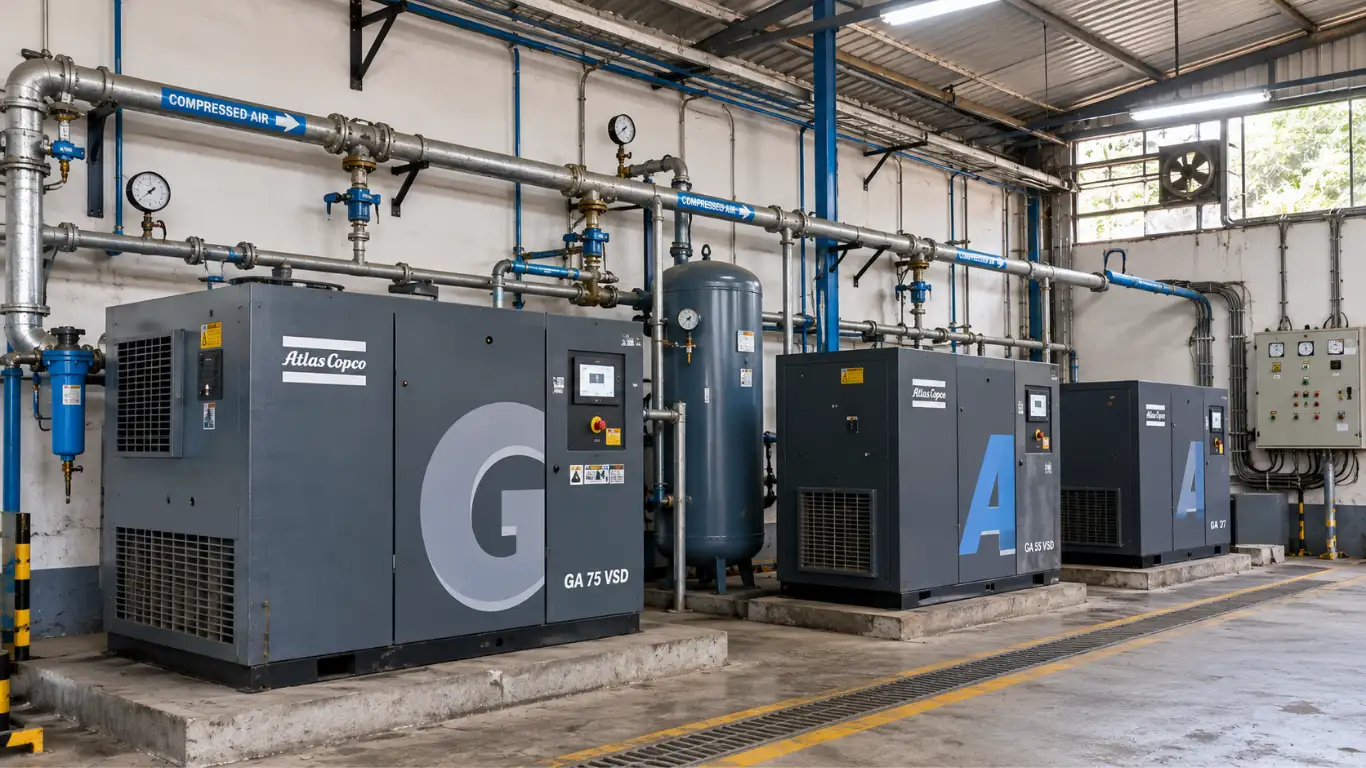
Compressed air is often considered one of the most expensive utilities in manufacturing, largely because of how inefficient the generation process is to begin with — only a fraction of the electricity a compressor consumes actually ends up as usable air energy. Leaks make that inefficiency worse in three specific ways:
- Higher electricity consumption — compressors are already one of the largest electrical loads in most plants, and leaks directly inflate that load.
- Increased compressor cycling and wear — a leaking system makes compressors switch on and off more frequently, shortening equipment life and increasing maintenance costs.
- Reduced system pressure — leaks can starve pneumatic tools and equipment downstream, sometimes causing slowdowns that get blamed on the machinery instead of the leak.
Multiply a single leak’s impact across dozens of joints, valves, fittings, and hose connections across a facility, and the losses compound fast. It’s rarely one leak that’s the problem — it’s twenty small ones nobody has mapped.
If rising electricity bills are affecting your plant beyond just compressed air, our Energy Audit can identify additional energy-saving opportunities across your wider facility.
Why You Can't Just Listen for Leaks
The obvious question is: if leaks waste this much energy, why doesn’t someone just walk around and listen for them? Because most leaks are ultrasonic — they hiss at a frequency well above what the human ear can pick up, especially over the background noise of a running plant. Machinery hum, compressor noise, and general shop-floor activity mask the sound almost completely.
That’s exactly why leaks costing a facility real money can go undetected for months, sometimes years. They aren’t hidden because they’re small. They’re hidden because the plant environment drowns them out.
Most Compressed Air Leaks Occur At
Before any survey, it helps to know where leaks typically hide. Across Indian industrial plants, the most common leak points are:
- Quick couplers
- Hose reels
- Pipe joints
- FRL units (filter-regulator-lubricator)
- Solenoid valves
- Flexible hoses
- Compressor discharge lines
- Drain valves
These points see the most vibration, wear, and connect/disconnect cycles — which is exactly why they’re worth checking first, and exactly what an acoustic imaging scan is built to catch.
How Acoustic Imaging Detects Compressed Air Leaks
One question comes up in nearly every fire extinguisher training session we run: which extinguisher do I actually grab? Fair question, and the answer depends on what’s burning.
- Water, for ordinary combustibles like paper, wood, and textiles (Class A)
- Foam, for flammable liquids and Class A materials, though not near live electrical equipment
- CO₂, for electrical fires and flammable liquids, and it leaves no residue on sensitive equipment
- Dry Chemical Powder, a multi-purpose option effective on Class A, B, and C fires
- Wet Chemical, built specifically for commercial kitchens and cooking oil or fat fires (Class K)
Fire Safety Training Methodology
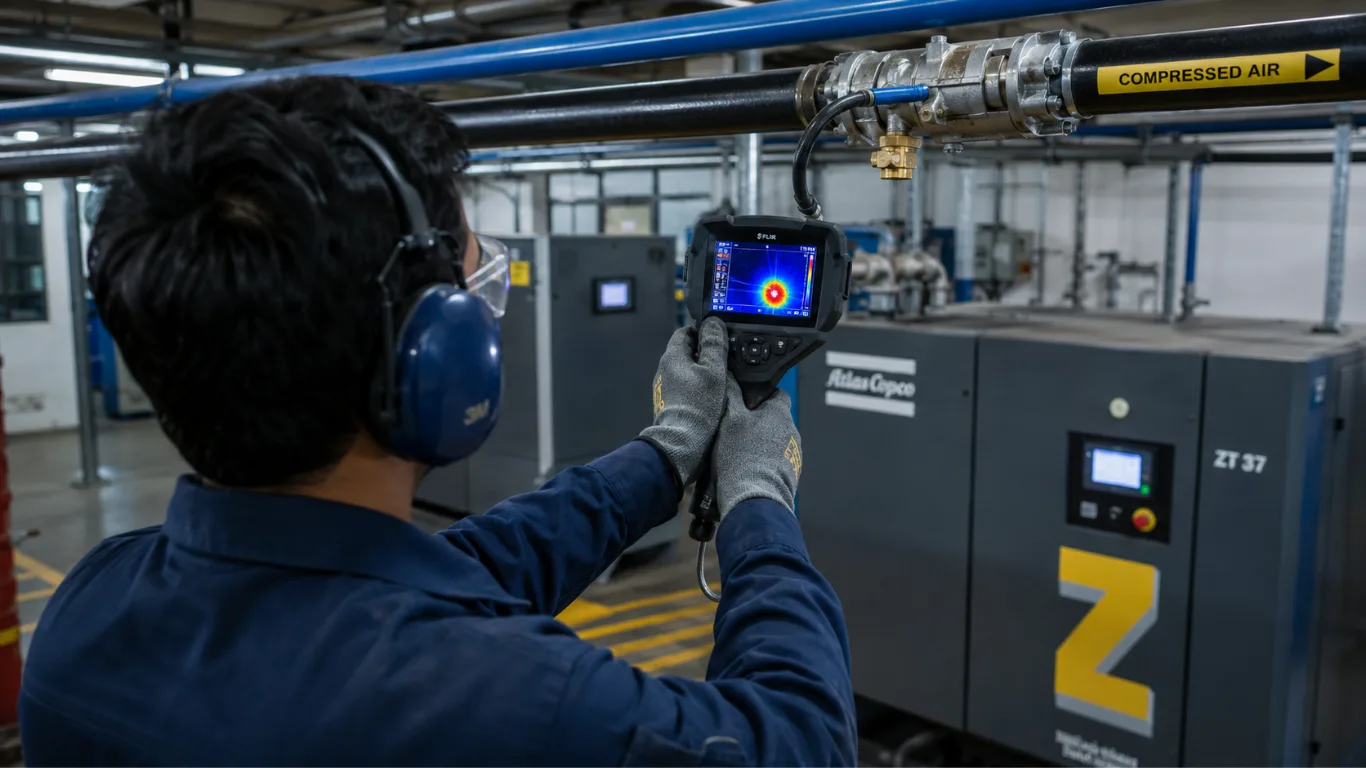
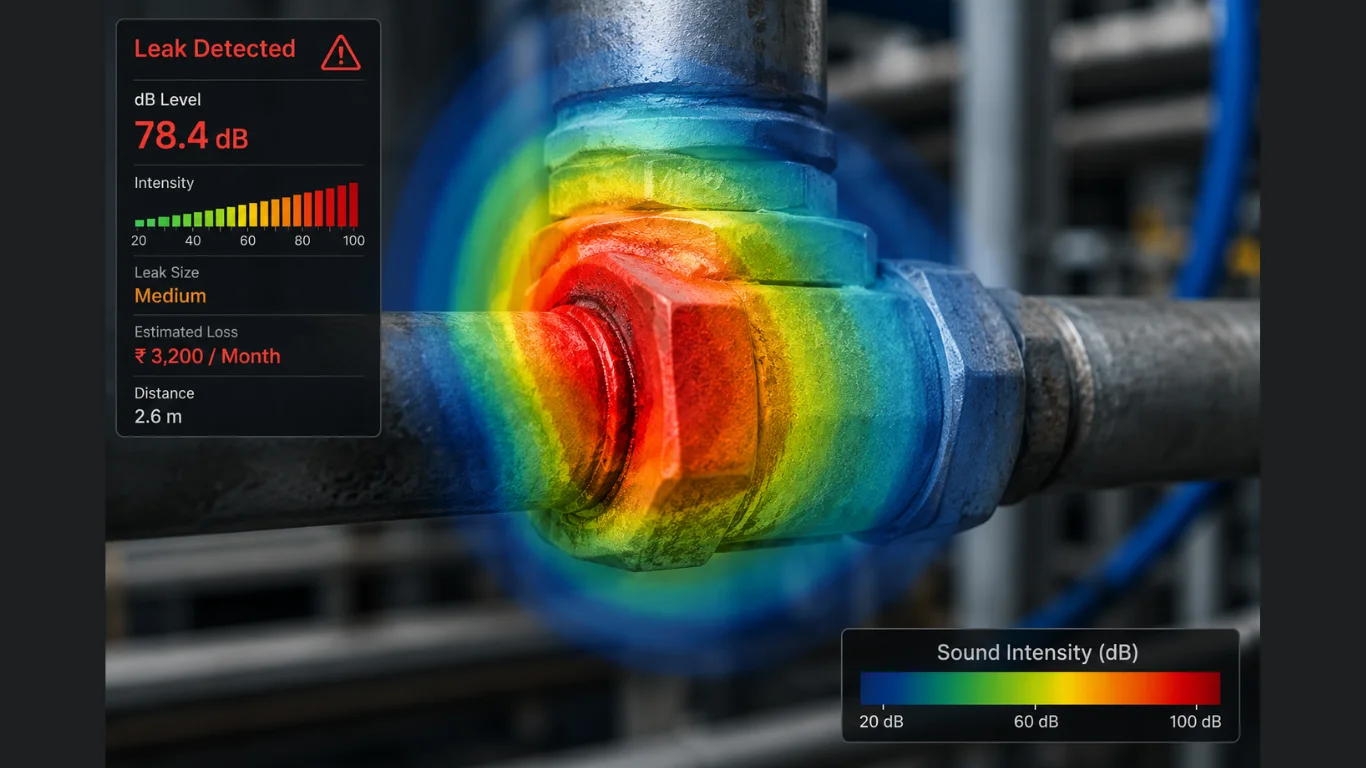
This is where acoustic imaging comes in. Instead of relying on a technician’s ears, an acoustic imaging camera picks up the ultrasonic sound a leak produces — frequencies invisible to human hearing — and converts it into a colour-coded image that points directly at the leaking joint, valve, or fitting.
Singh Isotech’s Acoustic Imaging & Compressed Air Leak Detection Service uses this exact technology, run by trained specialists across Indian industrial plants.
A proper compressed air leak survey doesn’t just confirm you have leaks. It gives you:
- The exact physical location of each leak, tagged for the maintenance team
- A decibel severity reading for each one
- An estimated leak rate and projected annual cost in rupees
- A repair-priority ranking, so the most expensive leaks get fixed first — not just the loudest ones
That last point matters more than it sounds. Not every leak costs the same. Ranking leaks by actual cost impact means your maintenance budget goes toward fixes that pay for themselves fastest, instead of guesswork.
What a Leak Survey Actually Involves
A well-run compressed air leak audit is non-intrusive by design — there’s no reason it should interrupt production:
- Scoping call — understanding your facility size, equipment, and any known problem areas
- On-site scan — a trained acoustic imaging specialist walks the facility during normal operating hours
- Data analysis — every flagged sound is classified as a leak, electrical discharge, or mechanical fault
- Reporting — annotated images, severity levels, and cost estimates in rupees, typically within 24 hours
- Rectification support — connecting you with a vendor network if repairs are needed
- Post-repair verification — a re-scan of tagged points to confirm the fix actually worked
Because the scan happens while your plant is running, there’s no shutdown, no production loss, and nothing to factor into a downtime decision. Every survey is performed by trained thermographers and acoustic imaging specialists, using non-contact testing — so nothing about the process touches or disrupts live equipment.
How Much Can Your Factory Save?
If a facility is losing even a fraction of the typical 20–30% leak rate, the annual electricity cost of that waste is usually far higher than the cost of the survey itself — which is why leak detection surveys tend to pay for themselves within the first few months after repairs are made. Many facilities recover the full cost of a survey after repairing just a handful of their largest leaks.
What Determines a Leak’s True Cost
Leak cost isn’t a single fixed number per millimetre — it depends on the leak’s flow rate, operating pressure, compressor efficiency, load/unload behaviour, operating hours, and your electricity tariff. That’s why a generic formula can only ever give a rough sense of scale. During an acoustic imaging survey, Singh Isotech calculates the estimated annual cost for each detected leak individually, using the actual severity reading captured on-site — so the number in your report reflects your plant, not an industry average.
Beyond the direct energy savings, fixing leaks also reduces compressor wear, extends equipment life, and takes pressure off compressed air infrastructure that’s already working harder than it should.
Signs Your Plant Needs a Leak Survey
You likely have leaks worth investigating if:
- Your compressor electricity bill has crept up without a change in production volume
- Your air compressor cycles on and off more frequently than it used to
- Pneumatic tools or equipment seem to be losing pressure or performance
- It’s been more than 12 months since your last compressed air leak survey
Without Leak Detection vs. With Acoustic Imaging
Without Leak Detection | With Acoustic Imaging |
Hidden leaks | Exact leak location |
Higher electricity bills | Lower energy costs |
Manual inspection | Visual acoustic images |
No cost estimates | Leak cost in ₹ |
Compressor wear | Longer equipment life |
Guesswork repairs | Prioritised, ROI-based repairs |
Frequently Asked Questions
Many facilities lose 20–30% of their compressed air to leaks. Identifying and repairing them can significantly cut energy waste and lower annual electricity costs — exact savings depend on operating pressure, compressor efficiency, and how many leaks are found.
No. Acoustic imaging surveys are non-contact and non-intrusive, so they’re carried out while your plant continues normal operations.
Most facilities benefit from an annual survey. Plants with continuous compressed-air use or older infrastructure may want to audit twice a year.
Most leaks develop at threaded joints, hose connections, quick-couplers, valves, and worn seals — often from vibration, age, or poor-quality fittings rather than any single failure.
Leaks are most common at pipe joints, flexible hoses, condensate traps, filters, regulators, and disconnect points near point-of-use equipment.
Well-maintained systems with an active leak-management programme typically run under 10% loss. Anything above 20% signals it’s time for a survey.
Yes. The same technology also picks up gas and vacuum system leaks, early-stage electrical partial discharge in switchgear, and mechanical wear in bearings and motors.
If early electrical faults are a concern, our Electrical Safety Audit is built specifically to catch partial discharge and switchgear issues before they cause downtime, and our Thermography Study complements acoustic imaging by flagging heat-related faults that sound alone won’t catch.
Ready to Find Out What Your Leaks Are Costing?
Wondering how much your compressed air leaks are really costing you? Singh Isotech can inspect your facility using advanced acoustic imaging cameras — without shutting down production. Within 24 hours, you’ll receive:
- Exact leak locations, tagged for your maintenance team
- Estimated annual cost of each leak, in rupees
- A repair-priority list
- An ROI estimate for fixing them
Contact our team today to schedule a free site assessment.
Reviewed by Singh Isotech’s Electrical Safety & Predictive Maintenance Team
Experienced in acoustic imaging, thermography, and industrial energy audits across automotive, pharmaceutical, food processing, textile, and cement plants in India.

