
- April 13, 2026
- 0 Comment
Last year, a manufacturing plant in Pune lost three days of production to an electrical fire. The panel that caught fire had been “visually inspected” just two months prior. Nothing looked wrong. But inside, a loose busbar connection had been quietly building heat for months.
An infrared inspection would have caught it in under 10 minutes.
So What Exactly Is Electrical Infrared Inspection?
It’s a thermal imaging scan of your live electrical systems — panels, switchgear, transformers, MCCs, cable joints, the works — while everything keeps running normally. No shutdown. No disruption.
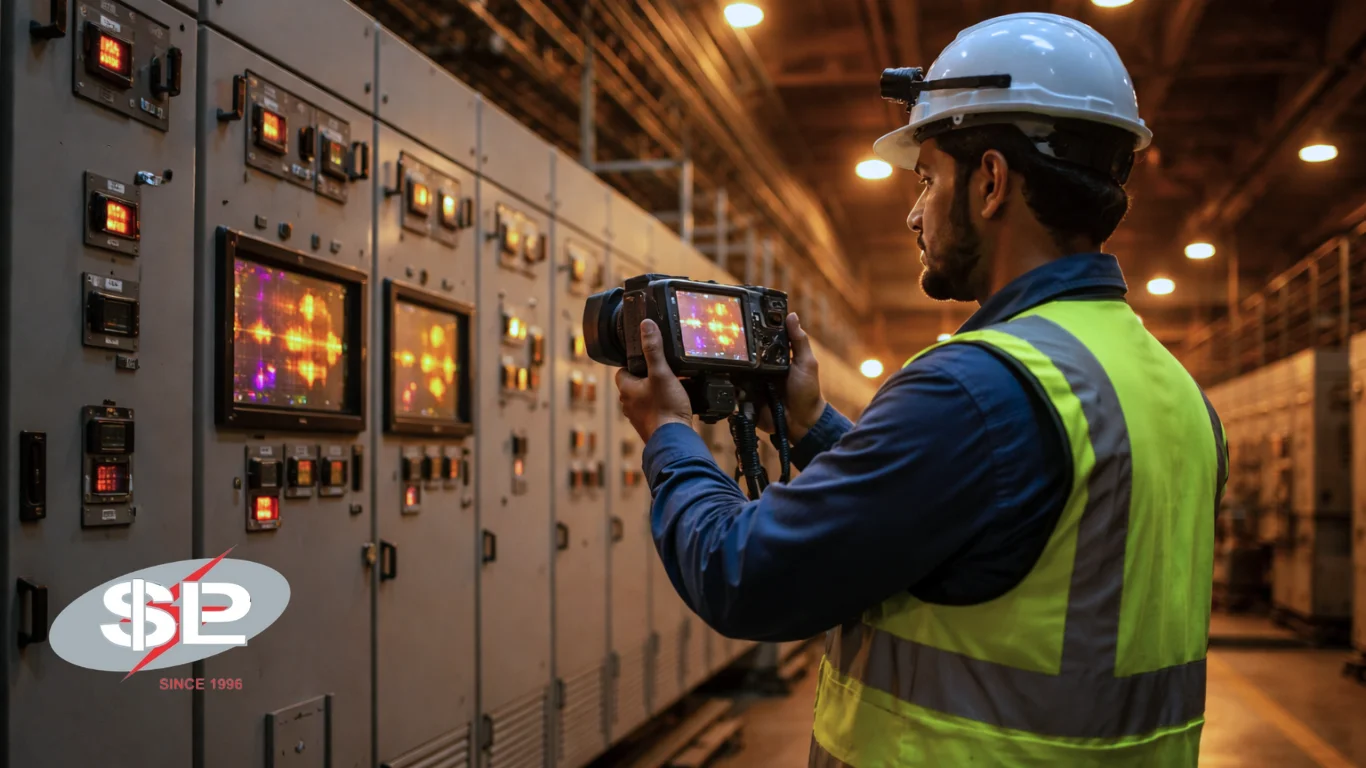
A certified thermographer points a high-resolution infrared camera at your electrical equipment. The camera reads heat signatures invisible to the human eye. Loose connections, overloaded circuits, failing breakers — they all run hotter than they should. The camera sees it. We document it. You fix it before it becomes a fire, a failure, or a fine.
That’s the whole idea behind our Thermography Study service — catch the heat before it catches you.
Why Does Electrical Equipment Overheat?
Five reasons account for 90% of what we find during inspections:
Loose connections — The most common culprit. Even a slightly loose terminal adds resistance. Resistance creates heat. Heat degrades insulation. Insulation failure causes arcing or fire.
Overloaded circuits — Loads added over the years without upgrading the distribution system. Common in facilities that have expanded piecemeal.
Unbalanced three-phase loads — One phase carrying far more than the other two. Shows up clearly on thermal imaging. Quietly destroying transformers and motors in the background.
Corroded joints — Particularly bad in coastal cities, humid warehouses, and chemical plants. High resistance even at normal loads.
Aging components — Breakers, capacitors, and contactors past their service life. They don’t fail suddenly. They heat up gradually, then fail at the worst possible time.
What Gets Inspected?
A thorough electrical infrared survey covers:
Main LT/HT panels and switchgear, distribution boards, bus bars and bus ducts, circuit breakers and fuses, capacitor banks, transformers, motor control centres (MCCs), VFDs, cable terminations and joints, and UPS/battery banks.
For plants with heavy machinery, we extend the scan to motors and bearings as well — two-for-one diagnostic value in a single visit.
Read More :- Electrical Safety Audit: Top 5 Hidden Risks
No Shutdown. Zero Disruption.
This is the question every plant manager asks first — and the answer is no, you don’t need to shut anything down.
All scanning happens on live, energised equipment. Your operations run as normal. Our team works around your schedule, during peak load if possible, because that’s when anomalies show up most clearly on thermal imaging.
It’s the same principle behind our broader Electrical Safety Audit approach — advanced diagnostics without operational disruption.
How Often Should You Get It Done?
Annual minimum for most industrial and commercial facilities.
Every 6 months for hospitals, data centres, pharma plants, and cold chain facilities where a failure isn’t just expensive — it’s dangerous.
Within 3 months of commissioning any new or modified electrical system, to catch installation issues before they become embedded problems.
NFPA 70B (2023 revision) now mandates thermal inspections at least once every 12 months. India’s CEA Regulations require electrical systems to be maintained in safe working condition — and documented thermography is among the strongest evidence you can present.
Singh Isotech has conducted energy audits for clients including Blinkit, OYO, Cloud Nine, HDFC Life, IKEA, Starbucks, DLF, and many others — spanning hospitality, healthcare, retail, and industry.
What You Get After the Inspection
Report delivered within 24 hours. Every anomaly documented with:
A thermal image and matching visible-light photograph, temperature differential reading, severity classification (Priority 1 / 2 / 3), and a specific repair recommendation.
No vague language. No “monitor this.” If something needs fixing, the report tells you exactly what, where, and how urgently.
Where rectification is needed, Singh Isotech’s team can manage the repair works end-to-end through our post-audit rectification programme — the same team that found the problem helps you close it out.
How It Fits into Your Broader Safety Programme
Infrared inspection isn’t a standalone exercise. It’s most effective as part of a layered electrical safety strategy:
Pair it with an Electrical Safety Audit for full system-level compliance assessment. Combine it with a Power Quality Study to understand whether harmonics and voltage fluctuations are contributing to the overheating. Add an Arc Flash Study to understand the incident energy at each panel — critical for worker safety protocols.
If you’re working toward BEE compliance, thermal imaging also quantifies energy losses through poor connections — making it a useful input for your Energy Audit too.
Who Needs This Most?
Any facility with a meaningful electrical load. But these industries see the sharpest ROI:
Manufacturing plants, warehouses, and logistics parks where unplanned downtime directly hits the bottom line. Hospitals and healthcare facilities where electrical failure is a patient safety issue. Retail malls and commercial complexes running heavy HVAC and lighting loads. Data centres and IT facilities where a single panel failure can cascade into serious business disruption. Pharmaceutical and food processing plants where both fire risk and product integrity are on the line.
FAQs
Q: What is electrical infrared inspection?
A: Thermal imaging scan of live electrical systems to detect heat anomalies before they cause failure.
Q: Is shutdown required?
A: No — fully live-line inspection, zero operational disruption.
Q: How often should it be done?
A: Annually at minimum; every 6 months for critical facilities.
Q: What does the report include?
A: Thermal images, temperature readings, severity classification, and repair recommendations for every fault found.
Q: Does it detect overloaded circuits?
A: Yes — overloaded circuits run hotter and appear clearly on thermal images.
Q: Is it the same as thermography?
A: Yes — thermography and infrared inspection refer to the same technique.
Q: What standards apply in India?
A: CEA Regulations, ISO 45001:2018, and NFPA 70B internationally.
Q: How soon is the report delivered?
A: Within 24 hours of the inspection.
Q: What cameras does Singh Isotech use?
A: FLIR and FLUKE-grade thermal cameras operated by certified Level II thermographers.
Q: Can it prevent electrical fires?
A: It significantly reduces the risk — provided identified faults are actually repaired.
Book Your Electrical Infrared Inspection
30 years. 1,500+ audits. IIT and BITS-Pilani engineers. FLIR/FLUKE instruments. Report in 24 hours.
If your panels haven’t been thermally scanned in the last 12 months, they’re overdue.
Call +91-9999888902 or visit singhisotech.com/contact-us for a free consultation.

