
- September 14, 2026
- 0 Comment
Most electrical accidents on Indian factory floors don’t happen because nobody knew the rules existed. They happen because the person doing the work was never actually trained on what those rules mean in practice —how to properly isolate a circuit, safe clearance from a live panel, and what a test record needs to show to hold up later. Electrical safety training is what helps a technician apply CEA regulations and IS 732 correctly on the shop floor, rather than treating them as documents that only matter when an inspector visits.
This guide breaks down what those two frameworks actually require, what a properly structured training programme should cover, and how it fits alongside statutory testing and audits.
What Is Electrical Safety Training?
Electrical safety training teaches technicians, supervisors, and facility managers how to work around electrical installations without creating a hazard — for themselves or anyone else. That includes safe isolation before maintenance, correct PPE selection, recognising warning signs of failing equipment, and documenting inspections in a way that satisfies both internal safety standards and statutory requirements.
It’s not the same as a general induction safety briefing. Electrical work carries specific risks — shock, arc flash, fire — that need dedicated, hands-on training rather than a slide deck covered once a year.
Why Electrical Safety Training Matters for Indian Industrial Facilities
A few conditions make this particularly relevant for Indian industrial and commercial facilities specifically. Many installations run well beyond their original design life, often with incomplete or outdated documentation from earlier renovations. Electrical maintenance is frequently handled by a mix of in-house staff and outsourced contractors, which makes consistent safety practice harder to maintain across a site. And under the CEA’s 2023 regulations, facilities are expected to designate responsible persons and carry out periodic statutory testing — obligations that depend entirely on having people who know how to do that work correctly, not just people who’ve been told it needs doing.
The Cost of Skipping Electrical Safety Training
Untrained work around electrical systems tends to surface as one of two outcomes: a near-miss that gets quietly logged and forgotten, or an incident that can’t be. Between those two extremes sits a slower, less visible cost — failed statutory inspections, insurance claims complicated by missing documentation, and client audits that flag gaps a trained team would have caught months earlier. None of that shows up as a line item until it does.
CEA Regulations and What They Require
The Central Electricity Authority (Measures relating to Safety and Electric Supply) Regulations, 2023 — issued under Section 177 of the Electricity Act, 2003, and superseding the 2010 regulations — set out the statutory safety framework for electrical installations in India. A few specific provisions are worth knowing precisely, rather than in general terms:
Designated persons (Regulation 3): any supplier, consumer, or owner of an electrical installation must designate specific persons to operate and carry out work on electrical lines and apparatus, and maintain a record of who they are. A designated person must hold a certificate of competency or electrical work permit issued by the Appropriate Government.
Electrical Safety Officer (Regulation 5): Regulation 5(1) requires that “all suppliers of electricity including generating companies, transmission companies and distribution companies shall designate an Electrical Safety Officer.” Separately, Regulation 5(3) applies this to consumer-side installations — specifically, any factory registered under the Factories Act, 1948 with a connected load above 250 kW, and mines or oil-fields with a connected load above 2000 kW, must designate an Electrical Safety Officer holding an electrical engineering degree (5+ years’ experience) or diploma (10+ years’ experience).
Periodic testing: where an Electrical Safety Officer is required under Regulation 5, they must carry out periodic tests and inspect the installation at intervals not exceeding one year, with records kept in the prescribed format. Separately, general statutory inspection or self-certification under Regulation 32 follows a periodicity set by the Appropriate Government, capped at five years — so the applicable interval depends on which provision covers a given installation.
These thresholds and testing intervals can vary depending on the type and circumstances of the installation, so facilities should confirm which specific provisions apply to them rather than relying on a single blanket requirement. Factors such as connected load, factory registration status, and the nature of the installation can affect the applicable requirements. In practice, compliance also depends on having competent personnel who understand the relevant procedures, can perform designated electrical work safely, and can carry out and properly document the required inspections and tests.
What IS 732 Covers
IS 732:2019, the Bureau of Indian Standards’ Code of Practice for Electrical Wiring Installations (Fourth Revision), is the core technical reference for wiring in India — covering the design, selection, installation, inspection, and testing of electrical wiring installations. It’s referenced directly by CEA regulations as part of the technical basis for statutory compliance, which is why electrical safety training programmes typically walk through its key provisions rather than treating it as a separate, optional standard.
Earthing specifically sits under a companion standard, IS 3043:2018 (Code of Practice for Earthing), which IS 732 references for protective earthing requirements. It provides guidance on earthing system design, electrodes, measurement methods, and the factors that determine acceptable earth resistance for a given installation — the technical detail a technician actually applies when carrying out the earth resistance checks CEA regulations require. A training programme that covers IS 732 without touching IS 3043 leaves out the standard most earth-testing findings actually get measured against.
For a facility team, the practical value of these standards isn’t memorising clause numbers. It’s understanding what “correctly wired and protected” actually looks like, so a technician can recognise a non-compliant installation on sight rather than relying entirely on the next scheduled workplace and HSE audit to catch it.
What Does Electrical Safety Training Cover?
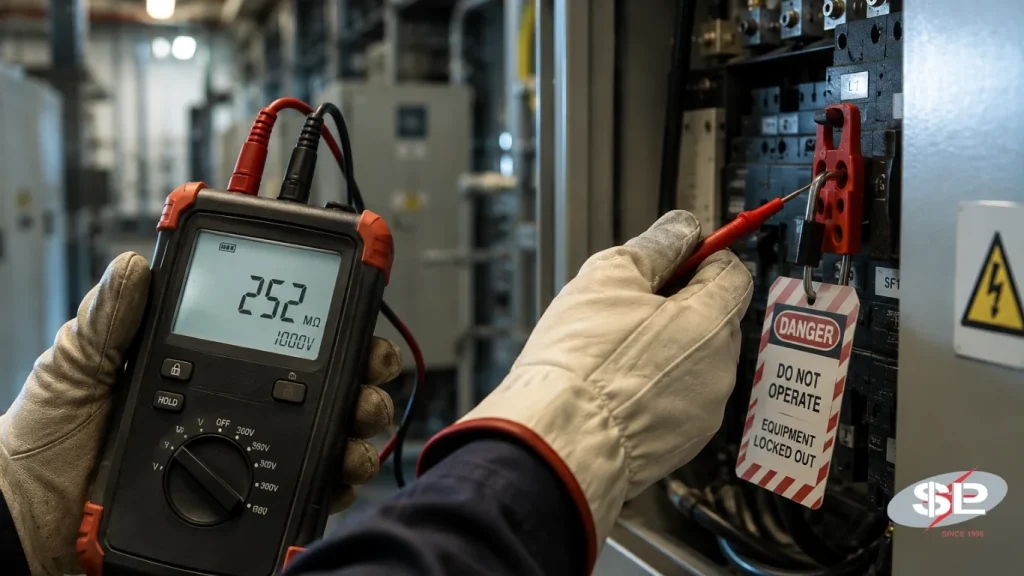
A properly structured programme covers a defined set of practical skills rather than a broad, generic overview. At minimum, that includes:
Safe isolation and lockout-tagout — de-energising equipment correctly before any maintenance work begins.
PPE and safe approach distances — what to wear and how close is safe around live or recently isolated equipment.
Arc flash awareness — recognising the risk around switchgear and panels, even without a dedicated arc flash study.
Earthing and testing — carrying out and correctly recording earth resistance and insulation tests.
Incident reporting — what counts as a reportable near-miss or incident, and the correct escalation path.
What Actually Happens On Site: The RCC Building Health Check
For a facility positioning this as a genuine training resource rather than a one-off briefing, a complete industrial electrical safety programme typically works through:
Electrical hazard identification and shock/electrocution prevention; safe isolation procedures and verification of absence of voltage before work begins; lockout-tagout (LOTO) practice; correct PPE selection and use; safe working around electrical panels and switchgear; earthing and continuity checks; electrical fire prevention and response; arc-flash awareness and protective measures; emergency response and basic first aid/CPR considerations relevant to electric shock; incident and near-miss reporting; contractor electrical safety expectations; and permit-to-work procedures for live or isolated equipment. Not every session needs to cover all of these in equal depth, but a programme that skips several of these areas may not provide comprehensive coverage for an industrial facility.
What a Compliant Electrical Safety Programme Looks Like
Training lands better when it’s tied to an actual process rather than delivered as a one-off session. A reasonable sequence looks like this:
- Identify all electrical installations and equipment on site, including voltage class and age.
- Assign a designated Electrical Safety Officer or responsible person, as CEA regulations require.
- Map which installations fall under periodic statutory testing and inspection.
- Train technicians and supervisors on isolation, PPE, and safe working procedures before they touch live or de-energised equipment.
- Carry out earth resistance, insulation, and continuity testing at the required intervals.
- Record every test, inspection, and corrective action in a format that can be produced on demand.
- Review incidents and near-misses to catch recurring issues before they become accidents.
- Refresh training whenever new equipment is commissioned or after any electrical incident.
Electrical Safety Training vs. Just Having a Safety Checklist
A checklist tells someone what to inspect. Training tells them why a reading matters, what a dangerous deviation looks like, and what to do about it before it becomes a hazard. Two facilities can run the same checklist and get very different safety outcomes — one team is genuinely inspecting, the other is filling in boxes.
Who Should Attend Electrical Safety Training?
Maintenance technicians and electricians are the obvious audience, but they’re not the only one. Shift supervisors need enough grounding to recognise when something’s been done incorrectly. Facility managers need to understand what CEA compliance actually requires so they can brief contractors and defend the programme during an audit. And anyone who signs off on statutory test certificates needs to understand what they’re actually certifying. Electrical safety training is often delivered alongside broader safety training programmes so a facility isn’t running separate, disconnected sessions for every hazard category.
What Should an Electrical Safety Training Programme Include?
For a facility manager evaluating a training provider, it helps to see exactly what’s covered before committing. A reasonably complete electrical safety training programme should include the following:
Training Area | What Employees Learn |
CEA regulatory basics | Designated persons, Electrical Safety Officer role, periodic testing obligations |
IS 732 fundamentals | Wiring, protection, earthing, and inspection requirements for LV installations |
Isolation and LOTO | Safe isolation of circuits and lockout-tagout before any maintenance work |
PPE and safe approach distances | Correct PPE selection and safe working distances around live equipment |
Arc flash awareness | Recognising arc flash risk and working safely around switchgear and panels |
Earthing and testing | Earth resistance checks per IS 3043, insulation testing, and recording results correctly |
Incident and near-miss reporting | What to report, to whom, and within what timeframe |
Documentation and audit readiness | Maintaining test records and certificates that hold up under review |
Electrical Safety, Audits and Compliance in India
Training and auditing work as two halves of the same compliance picture. Training reduces everyday risk by making sure the people doing the work know what they’re doing. An electrical safety audit independently verifies whether the installation itself — wiring, protection, earthing, documentation — actually meets IS 732 and CEA requirements. Facilities that treat these as connected, rather than separate, tend to catch gaps earlier and produce compliance records that hold up when it matters, whether that’s a statutory inspection, an insurance review, or a client audit. Where switchgear and panel risk is a specific concern, an arc flash study adds a more detailed, site-specific risk assessment on top of general training.
How Singh Isotech Conducts Electrical Safety Training
Singh Isotech has been delivering electrical audits and electrical safety training programmes for industrial and commercial facilities across India since 1996. Training is led by Chartered Electrical Engineers, and the organisation’s ISO 14001, 45001, and 50001 certifications reflect the same management-system discipline applied to how training content is structured and documented — not just how audits are run.
The content itself is drawn from the same field findings used in electrical audit and safety audit work — the specific isolation gaps, earthing failures, and documentation shortfalls seen repeatedly on Indian industrial sites — rather than a generic template built around the regulation text alone. Singh Isotech’s team has delivered over 800 hours of safety and compliance training across 15+ MNCs, and sessions are scheduled around plant shift patterns so training doesn’t require a production stoppage.
Frequently Asked Questions
Under the CEA Regulations, designated and competent persons are a prerequisite for undertaking electrical work. While training is not cited as a standalone requirement, the personnel fulfilling electrical safety requirements need to be trained.
CEA Regulations are the Statutory Safety Requirements under the Electricity Act, whereas IS 732 provides the specifications for the design, installation and testing of electrical wiring.
Persons working on or maintaining electrical installations may need to be designated under CEA Regulation 3. Certain facilities may also need to appoint an Electrical Safety Officer as per the noted conditions.
intervals for tests are prescribed in the respective CEA provisions. Some installations require annual tests while some may require inspections after a period of 5 years.
Yes. This includes awareness for arc flash, safe work practices, prescribed distances and personal PPE.
Yes. comprehensive training and safety records can help a company demonstrate a positive risk management view during audits and insurer assessments.
Training focuses on improving employees’ safety awareness and practices with respect to electrical systems, and an audit focuses on the condition of the safety system and electrical compliance.

