
- August 1, 2026
- 0 Comment
A spark near a storage rack. Smoke within seconds. And nobody in the room knows where the nearest extinguisher is kept. Sounds dramatic? It isn’t, not really. We’ve seen it happen in facilities that looked perfectly organized on paper. Fire safety training programs exist for exactly this gap, the one between panic and preparedness, and if you’re reading this, you’re probably already wondering whether your own team would know what to do.
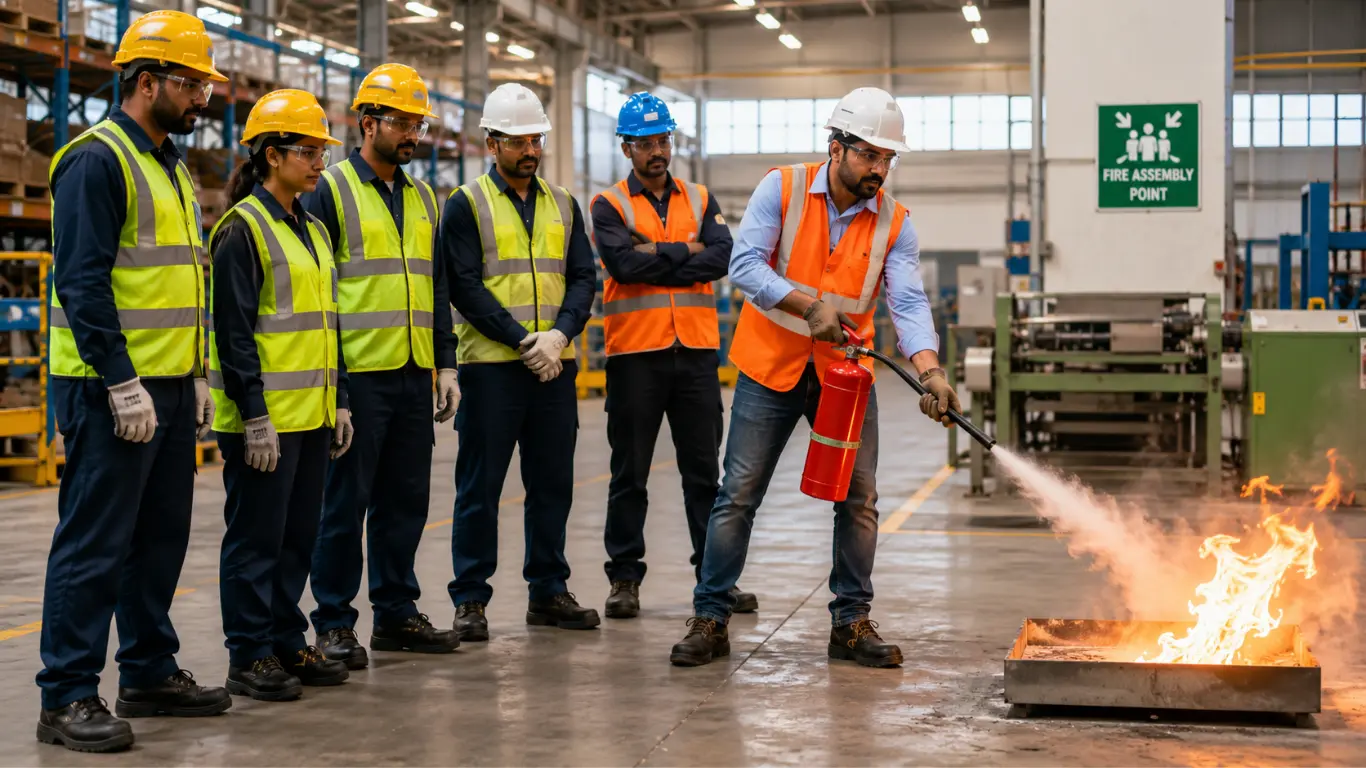
During a site assessment at a packaging unit, we found that the fire extinguishers were correctly installed, clearly tagged, and up to date with inspections. But when three employees were asked to demonstrate how to use one, only one could do it correctly. That’s the real gap. Having the right equipment is important, but it means little if people don’t know how to use it during an emergency. Practical fire safety training bridges the gap between compliance on paper and real-world preparedness.
What Are Fire Safety Training Programs Really?
Strip away the jargon and it comes down to this: fire safety training programs teach people how to spot a fire hazard before it becomes a fire, and how to act, not freeze, when one starts anyway. A single lecture won’t cut it. What works is a mix of classroom theory, hands-on extinguisher training, fire drill training, and emergency evacuation training, repeated often enough that it becomes muscle memory rather than a distant memory from an induction session two years ago.
The Compliance Angle You Can’t Ignore
In the US, OSHA requires employers to educate workers on fire hazards and emergency response, and wherever extinguishers are provided, annual refresher training isn’t optional, it’s mandatory under 29 CFR 1910.157. Skip it and you’re not just gambling with lives, you’re inviting fines and abatement orders too.
In India, the obligations sit under the Factories Act, 1948, which lays out safety provisions for factories, alongside the National Building Code of India, covering fire prevention and life-safety requirements for buildings more broadly. So no, structured fire safety training isn’t a nice-to-have here either. It’s the baseline every facility is expected to meet.
Why Fire Safety Training Matters: The Numbers
Here’s a stat worth sitting with: NFPA’s analysis of industrial and manufacturing property fires found that heating equipment, lighting, and electrical equipment were tied as the single leading cause of ignition, together accounting for around 14% of industrial and manufacturing fires. Electrical and equipment-related risk shows up consistently near the top of NFPA’s fire-cause data for these facility types. Not a small number. And the uncomfortable truth is that most of these are preventable, with the right awareness and a bit of maintenance discipline, which is precisely what good fire prevention training is meant to build.
Benefits of Fire Safety Training
Why bother investing beyond the minimum compliance checkbox? Because the payoff shows up in ways you can actually measure over time:
- Fewer workplace accidents and near-misses
- Less property damage, because response happens early and correctly
- Statutory compliance covered, under OSHA, the Factories Act, and NBC fire codes
- Faster, better-coordinated emergency response
- Employees who act with confidence instead of freezing up
- Lower insurance risk and premium exposure down the line
Types of Fire Extinguishers
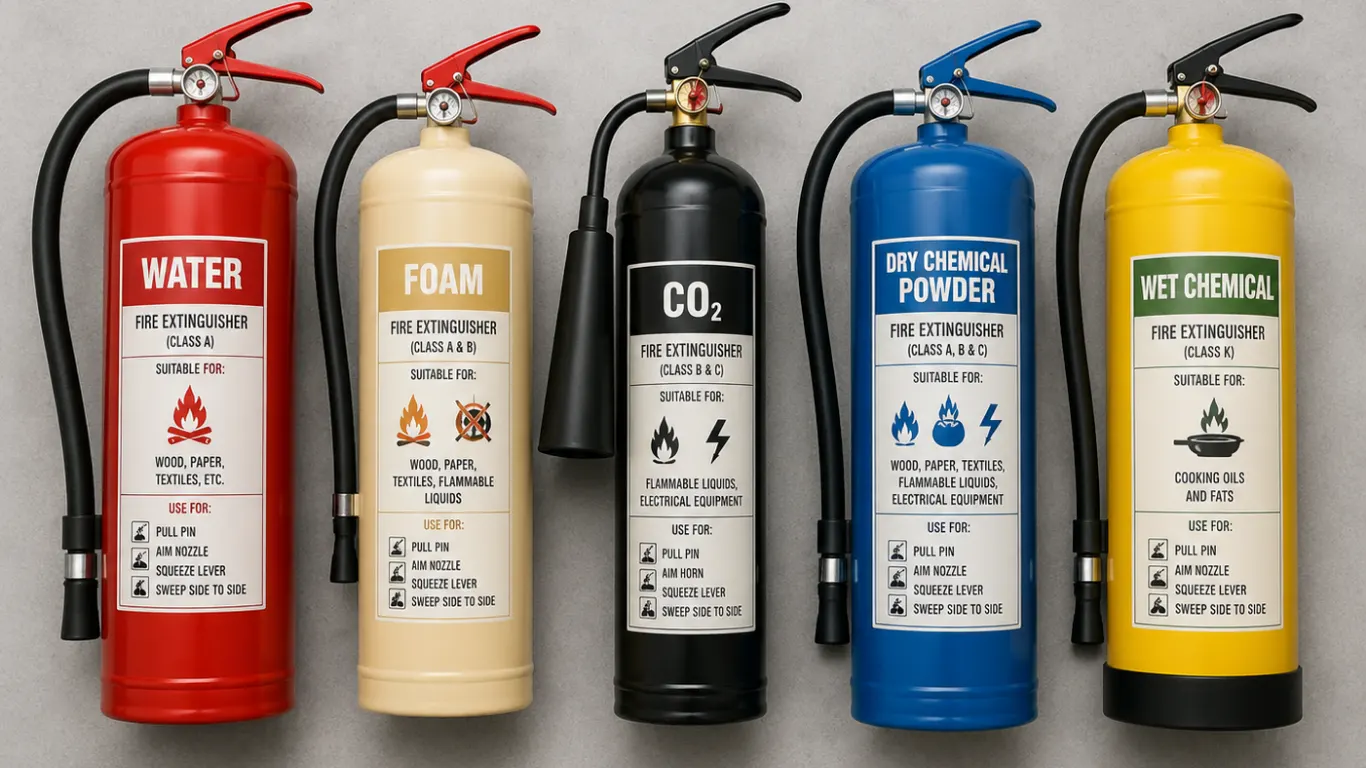
One question comes up in nearly every fire extinguisher training session we run: which extinguisher do I actually grab? Fair question, and the answer depends on what’s burning.
- Water, for ordinary combustibles like paper, wood, and textiles (Class A)
- Foam, for flammable liquids and Class A materials, though not near live electrical equipment
- CO₂, for electrical fires and flammable liquids, and it leaves no residue on sensitive equipment
- Dry Chemical Powder, a multi-purpose option effective on Class A, B, and C fires
- Wet Chemical, built specifically for commercial kitchens and cooking oil or fat fires (Class K)
Fire Safety Training Methodology
- Good fire fighting training doesn’t happen in one sitting. It follows a process, something closer to this:
- Assessment, evaluating current site hazards and gaps
- Classroom Session, covering theory, regulations, and fire behaviour basics
- Hazard Identification, actually walking the site to flag real risks
- Live Fire Demo, a controlled demonstration of how fire behaves
- Extinguisher Practice, hands-on time across different extinguisher types
- Mock Evacuation, a full emergency evacuation training drill, not a walkthrough
- Assessment, a competency check before anyone’s signed off
- Certificate, formal fire safety certification issued at the end
Online vs. On-Site Fire Safety Training
Can fire safety genuinely be taught online? Partly. Theory modules, hazard recognition, and compliance documentation translate reasonably well to e-learning, not unlike how electrical safety training online programs handle foundational concepts already. But extinguisher handling and evacuation drills? Those need to happen in person, full stop. Even ITCILO, one of the more established names in this space, structures its fire safety management courses around exactly this blended approach. Worth following.
Aspect | Online Training | On-site Training |
Focus | Theory | Practical |
Schedule | Flexible | Hands-on, fixed sessions |
Cost | Lower cost | Better retention |
Extinguisher Practice | Not included | Live extinguisher drills |
Best For | Refresher training | First-time learners |
Fire Safety Training Certification
A fire safety training certificate ought to mean more than just showing up. What we’d look for:
- An attendance certificate confirming participation
- A competency assessment testing actual understanding
- A practical evaluation during live extinguisher and evacuation drills
Anything short of that is really just a paper exercise dressed up as workplace fire safety.
How Often Should Training Be Repeated?
At least once a year, and sooner if your facility layout, equipment, or storage practices change significantly. Waiting for an incident to remind you is, frankly, the wrong strategy.
Pairing Fire Safety with Preventive Maintenance
Here’s something people tend to miss: a surprising number of fires trace straight back to poorly maintained equipment, not bad luck. Folding fire awareness into your maintenance and PPM training programs means your technicians start spotting fire risks during routine checks, well before an alarm ever goes off.
Related Safety Services Worth Bundling In
Fire safety training rarely works in isolation. It’s most effective as part of a wider industrial safety training and risk-management program, which is why we’d also point you toward:
Choosing the Right Fire Safety Training Partner
Not every training provider is cut from the same cloth. The good ones customize content to your site’s actual hazards, run live extinguisher drills instead of just talking about them, issue proper fire safety certification, and can scale across shifts without grinding operations to a halt. That’s really the difference between a certificate gathering dust on a wall and a workforce that knows exactly what to do when it matters.
At Singh Isotech, our Fire Safety Training Programs are built around exactly that philosophy, real hazards, real drills, real preparedness.
Frequently Asked Questions
Yes. In India, employers are expected to provide workplace fire safety training under applicable safety regulations, while OSHA requires it in the US where extinguishers are provided.
Anywhere from 30 minutes to a few hours, depending on how much hands-on drilling is involved.
Everyone on site, really, plus deeper, role-specific training for designated fire wardens and marshals.
Usually, yes. Audits typically find specific weak points, like corroded conductors or missing SPDs, that can be fixed without a full teardown.
Once a year at minimum, more often if your setting is higher-risk industrially.
Prevention training stops fires before they start. Fire safety training also covers what to do once one’s already happening.
It should, water, foam, CO₂, dry chemical powder, wet chemical, and which fire class each one is meant for.
Fires don’t send a warning. So don’t wait for an emergency to find out where the gaps in your team’s preparedness actually are. Schedule a customized Fire Safety Training Program with Singh Isotech and give your workforce the knowledge, and the muscle memory, to respond with confidence and stay compliant.

