
Electrical Compliance Certificate (CoC) and Electrical Safety Audit in South Africa
A clause-referenced electrical safety audit – with thermographic survey included as standard – for industrial and commercial facilities across South Africa, Nigeria, Kenya and Ghana. As one of the more established names running an electrical safety audit in Africa, we build every report around evidence a regulator, insurer or auditor can actually act on. In South Africa we also issue the electrical compliance certificate (CoC).
What an Electrical Safety Audit Delivers
An electrical safety audit is a physical inspection and test of your electrical installation against the applicable regulations, combined with a thermographic survey, producing a clause-referenced report that ranks findings by risk and tracks each one through to close-out. For teams running an electrical safety inspection in Africa for the first time, it is the evidence a facility needs to show the Occupational Health and Safety Act’s duty of care was actually discharged.
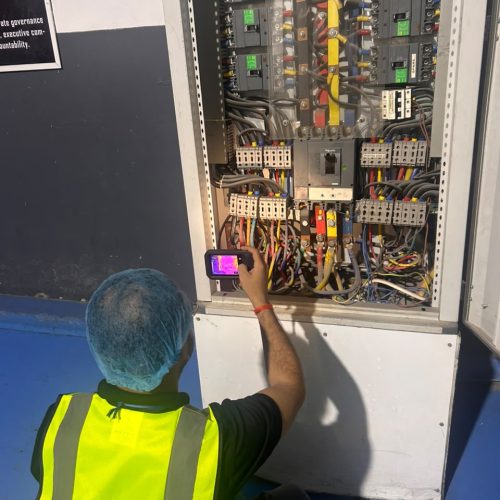
An audit is not the same thing as a Certificate of Compliance, and treating the two as interchangeable is one of the more expensive mistakes a facility can make. A Certificate of Compliance (CoC) confirms that an installation, at the point it was tested, met the wiring rules. An audit goes further: it looks at how the installation is actually used, where the load has grown since the last CoC was issued, where maintenance has lapsed, and where a hot spot is developing before it becomes a fault.
Most of our clients commission an audit first, use its findings to get the installation into a condition where a CoC can be issued without qualification, and then keep the audit on a maintenance cycle so drift gets caught before it becomes a defect. Every audit is delivered as a written report with photographs, thermal images, measured values and a clause reference for each finding – the same evidence a regulator, an insurer or an inspector actually asks to see. Where the duty traces back to South African law, that duty is set out in the Occupational Health and Safety Act 85 of 1993.
Read the full guide to employer duties under South African law.
What We Inspect
Distribution boards, protective devices and cabling
Every distribution board in scope is opened, inspected and tested – main and sub-boards, protective device ratings and coordination, cable sizing against actual load, and the condition of terminations. We check whether protective devices are rated correctly for the circuits they protect, whether discrimination between upstream and downstream devices works the way the single-line diagram says it should, and whether cabling has been added to a circuit since the original design without anyone updating the calculation. This is where most of the defects listed under ‘What we typically find’ below actually originate.
Earthing and bonding
Earth continuity, earth electrode resistance and equipotential bonding are measured, not assumed from the drawing. A facility can have a compliant-looking earthing system on paper and a genuinely dangerous one on site – corrosion at an earth electrode, a bonding conductor removed during other work and never reinstated, or an extension that was never tied back into the main earthing system. Each of these is a single-point failure that only shows up under fault conditions, which is exactly when you don’t want to discover it.
Risk assessment and documentation
Every finding is carried through a documented electrical safety assessment in Africa: likelihood, consequence, and a risk ranking that determines the order findings are closed out in – high-risk items first, not cheapest-first. Each finding is also referenced back to the specific electrical installation regulation it falls under, so the report reads as evidence, not opinion. This is the section of the report a facilities manager uses to build a remediation budget, and a safety officer uses to demonstrate, in writing, that risk was actually assessed rather than asserted. Where relevant we also review existing documentation – single-line diagrams, previous CoCs, maintenance records – and flag where the paper trail and the physical installation have drifted apart.
Thermographic survey - included as standard
A full infrared thermography survey is run across the installation on every electrical safety audit – it is not an optional add-on. This thermographic electrical inspection in Africa finds the failures a visual check cannot: a loose termination heating up under load, an overloaded neutral, a failing contact inside a switchgear panel, all invisible until they’re hot enough to see. Every thermal anomaly is documented with a matched visual photograph, a measured temperature, a load reading at the time of the scan, and a risk rating – so a hot spot found at 4pm on a Tuesday can’t be dismissed as a one-off reading.
How the Audit Runs
The audit runs in five stages. Duration depends on site size and board count, but the sequence is the same everywhere we work.
| Stage | What happens | Typical duration |
|---|---|---|
| 1. Scoping and document review | Single-line diagrams, previous CoCs and maintenance records reviewed before the site visit | 1–2 days, desk-based |
| 2. Site inspection and testing | Physical inspection, testing and thermographic survey of every board and circuit in scope | 1–3 days on site |
| 3. Findings and risk ranking | Every finding referenced to the applicable clause and ranked by risk | 3–5 days |
| 4. Draft report and review call | Draft report issued; findings walked through with your team before it’s finalised | Within a week |
| 5. Final report and remediation register | Final clause-referenced report issued with a live remediation register for close-out tracking | Same week |
Most facilities are back to normal operation the same day the site visit finishes – the audit doesn’t require shutting anything down unless a finding demands it.
What We Audit Against
In South Africa, electrical installations are audited against the Electrical Installation Regulations made under the Occupational Health and Safety Act, and against SANS 10142-1 – the wiring code that carries almost all of the technical detail the regulations reference. SANS 10142-1 covers everything from conductor sizing and protective device coordination to earthing arrangements and the requirements for a Certificate of Compliance. It is the standard an installation is tested against for a CoC, and it is the standard our findings are referenced to, clause by clause.
Where a facility operates outside South Africa, we audit against the equivalent local framework – see the country coverage table on the main Africa page – while keeping the same SANS-based method as the technical baseline, since it is one of the more rigorous wiring codes applied in the region.
What We Typically Find
Some findings show up on almost every industrial electrical safety audit we run across the continent. If your facility recognises more than one of these, that’s normal – it’s also exactly why the audit exists.
- Overloaded or undersized distribution boards, where load has grown since the original design and nobody re-ran the calculation.
- Incorrectly rated or miscoordinated protective devices, where an upstream breaker trips before the downstream one it’s meant to back up.
- Loose or corroded terminations – usually found first by the thermographic survey rather than by eye.
- Earthing and bonding gaps left by other contractors’ work – an extension, a renovation, a plant addition – never tied back into the main earthing system.
- Missing or out-of-date labelling, particularly arc flash and switching labels on panels modified since installation. Where incident energy hasn’t been assessed at all, this usually points to a wider gap an arc flash study would close.
- Documentation drift, where the single-line diagram no longer matches what’s actually installed, and the previous Certificate of Compliance no longer reflects the circuits in use.
High incident energy or unassessed arc flash risk found during the audit leads directly to a study.
Who Needs One
An electrical audit – or, more precisely, an electrical safety audit – is the right starting point for any facility that hasn’t had one in the last two to three years, that has added load or altered its installation since the last formal assessment, that is preparing for an insurance renewal or a due-diligence process, or that needs to demonstrate OHS Act compliance with more than a safety file. It’s also the natural next step after any incident, near-miss, or unexplained trip that hasn’t been fully explained.
Electrical safety is not a once-off certificate – it’s an ongoing discipline, and the audit is what keeps it honest between certificates. Manufacturing plants, warehouses, mines, hospitals, data centres and multi-tenant commercial buildings make up most of our client base for industrial electrical safety audit work across Africa – South Africa, Nigeria, Kenya and Ghana – anywhere with a distribution board carrying real industrial or commercial load.
Related Services
An arc flash model is only as good as the protection settings behind it, and the audit is what verifies them. High incident energy found during an audit leads directly to a study.
Same instrumentation, same site visit – a natural pairing rather than a separate project.
The electrical installation is the most common ignition source on an industrial site.
The pre-audit checklist our engineers work from – genuinely useful, which makes the email exchange feel fair.
Electrical Compliance Certificate (CoC) in South Africa
In South Africa an Electrical Certificate of Compliance (CoC) is required under the Electrical Installation Regulations, 2009, made under the Occupational Health and Safety Act 85 of 1993. It is needed for a new installation, after alterations or additions, and when a property changes hands. Singh ISO Tech issues electrical Certificates of Compliance (CoC) in South Africa after inspecting and testing the installation.
Our service is the electrical compliance certificate (CoC) and electrical safety audit. We inspect the installation against SANS 10142-1 (wiring of premises), record defects by clause and risk, and give you a ranked repair list, so the installation is ready to pass and we can issue the electrical CoC. Thermographic inspection can be added to find hot connections before they fail.
Frequently Asked Questions
What is an electrical safety audit?
A physical inspection and test of an electrical installation – distribution boards, protective devices, earthing and cabling – combined with a thermographic survey, delivered as a clause-referenced report that ranks findings by risk rather than listing them in the order they were found.
How often should electrical safety audits be conducted?
Annually for industrial sites and every two years for lower-risk commercial premises is a reasonable default, with a fresh audit triggered by any significant alteration, load increase, or incident regardless of where the site sits in that cycle.
What's the difference between an electrical safety audit and a Certificate of Compliance?
A Certificate of Compliance confirms an installation met the wiring rules at the point it was tested. An audit goes further, assessing how the installation is used today, where load has grown, and where maintenance has lapsed – most facilities use audit findings to get to a clean CoC, not the other way round.
Does the audit include thermographic inspection?
Yes. A full infrared thermography survey runs across the installation on every electrical safety audit as standard, not as an add-on line item.
What standards do you audit against?
In South Africa, against the Electrical Installation Regulations and SANS 10142-1. Outside South Africa, against the equivalent local framework, using the same SANS-based method as the technical baseline.
How long does an electrical safety audit take?
Typically one to three days on site depending on board count, with the final clause-referenced report and remediation register issued within a week of the site visit.
What is an electrical compliance certificate (CoC) in South Africa?
An Electrical Certificate of Compliance, often called an electrical CoC, is a document confirming that an electrical installation complied with the Electrical Installation Regulations and SANS 10142-1 at the time of inspection. Singh ISO Tech issues electrical CoCs in South Africa.
Who can issue an electrical CoC?
Singh ISO Tech can issue electrical Certificates of Compliance (CoC) in South Africa, following inspection and testing against SANS 10142-1.
How long is an electrical CoC valid?
The regulations do not set a fixed expiry date for an installation that stays unchanged, but a new CoC is needed after alterations or additions. Buyers and insurers often ask for a recent certificate, and property transfers commonly expect one issued within the last two years.
What does SANS 10142-1 cover?
SANS 10142-1 is the South African code of practice for the wiring of premises at low voltage. It sets requirements for design, protection, earthing, earth leakage devices, cable selection, labelling and testing of fixed installations.
Africa Services
Book an electrical CoC and safety audit
Send us your board schedule and single-line diagram. We will scope the audit and quote it.

